
Every landlord learns the same lesson eventually: the cost of a repair is rarely the cost of the repair. It is the cost of the repair plus everything that failed while nobody was looking.
Good rental property maintenance is mostly about catching small things early. This guide covers what to inspect and when, who is legally responsible for what under BC tenancy law, what to handle between tenants, and where a handyman fits into keeping a rental in good shape across Coquitlam, Port Moody, Port Coquitlam, Burnaby and New Westminster.
Why preventative maintenance pays for itself
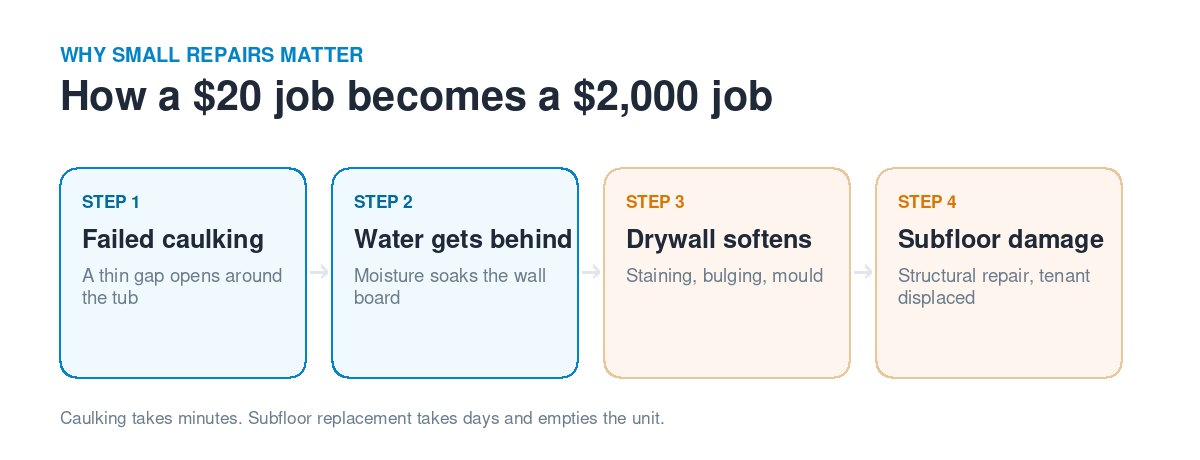
Reactive maintenance means waiting for a tenant to report a problem. By then the problem has usually been developing for weeks, and the repair is bigger than it needed to be.
The caulking example above is the one landlords see most often. A bead of silicone around a tub costs almost nothing and takes twenty minutes. Left to fail, water tracks behind the surround, softens the wall board, and eventually reaches the subfloor. At that point you are not doing a repair — you are doing a renovation, and the unit may be unrentable while it happens.
The same pattern shows up in gutters that overflow into fascia boards, door seals that let damp into frames, and small drywall damage that gets worse with every move-in and move-out.
Preventative maintenance is also a vacancy issue. A unit that shows well rents faster and attracts better applicants. Scuffed walls and a sticking bathroom door do not just look neglected; they signal to a prospective tenant that reported problems may not get fixed.
A seasonal rental property maintenance checklist
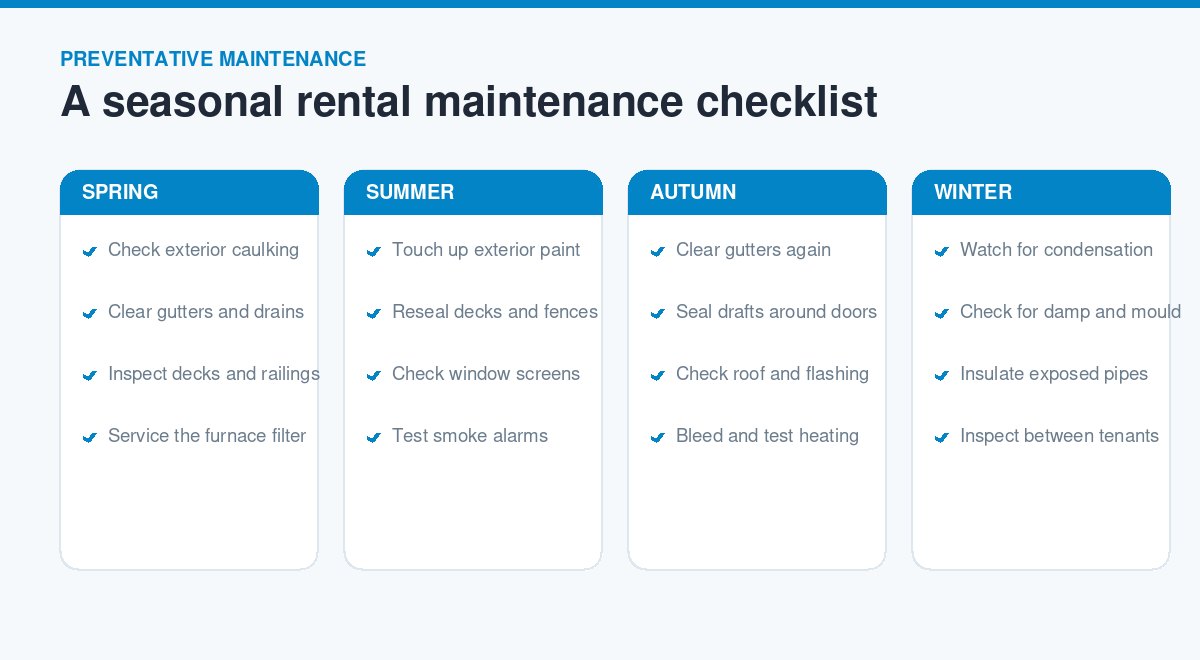
The wet Lower Mainland climate is hard on buildings. Water is the main enemy, and most of this checklist exists to keep it outside.
Spring
- Inspect exterior caulking around windows, doors and siding penetrations
- Clear gutters and downspouts, and check they drain away from the foundation
- Check decks, stairs and railings for rot and loose fixings
- Replace furnace and HVAC filters
Summer
- Touch up exterior paint and any exposed wood
- Reseal decks and fences while the weather is dry
- Repair window screens and check that windows open and lock properly
- Test every smoke and carbon monoxide alarm
Autumn
- Clear gutters again after leaf fall — this is the one most often skipped
- Seal drafts around doors and windows before heating season
- Check the roof and flashing from ground level for lifted or missing material
- Service the heating system before the first cold snap
Winter
- Watch for condensation on windows, an early sign of ventilation problems
- Check for damp patches, musty smells and early mould in bathrooms and closets
- Insulate exposed pipes in crawlspaces and unheated areas
- Follow up on anything a tenant has mentioned in passing
You do not need to attend every item personally. What matters is that someone does, on a schedule, rather than when a problem becomes obvious.
Who is legally responsible for repairs in BC?
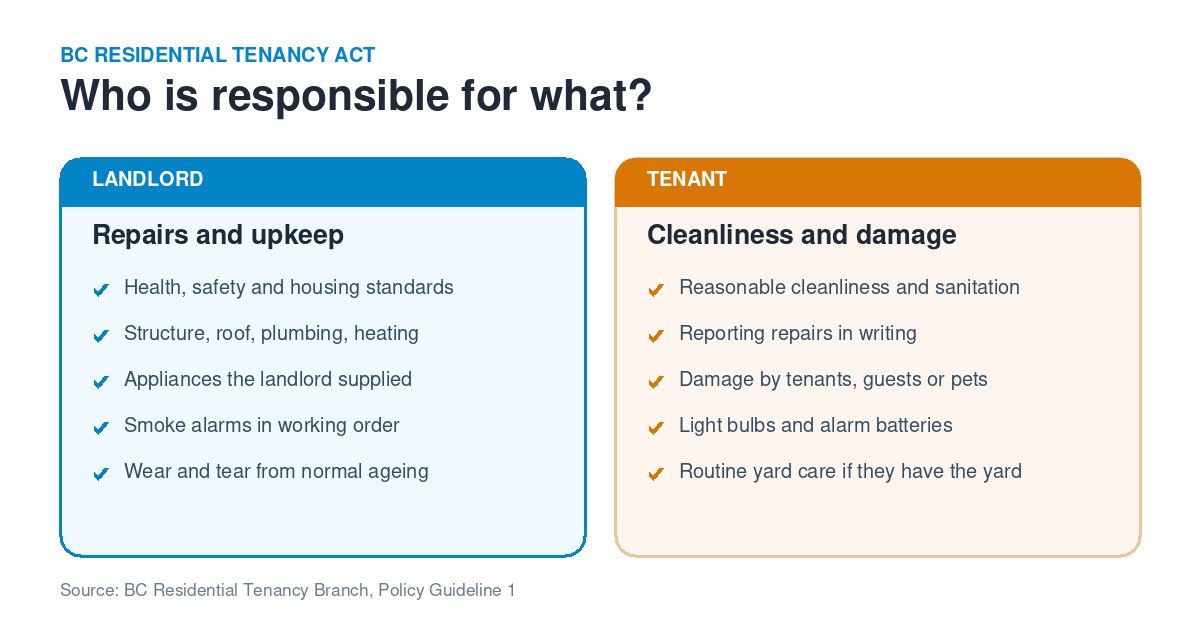
This is worth getting right, because a surprising number of tenancy agreements contain terms that are not enforceable.
Under the Residential Tenancy Act, landlords must ensure a rental property complies with health, housing and safety standards and is suitable for occupation. In practice that covers the structure, roof, plumbing, heating, electrical, locks, and any appliances the landlord supplied. The Province of British Columbia sets this out plainly: landlords are responsible for most rental unit repairs.
Tenants are responsible for reasonable cleanliness, for reporting problems in writing, and for damage caused by them, their guests or their pets. They are not responsible for reasonable wear and tear — the natural deterioration that comes from ordinary use over time.
The part landlords most often get wrong: you cannot make maintenance the tenant’s job through the lease. RTB Policy Guideline 1 states that a tenant cannot be required, as a condition of tenancy, to paint the premises or to maintain and repair landlord-supplied appliances. A term like that is unenforceable.
Smoke alarms are specifically the landlord’s responsibility to install and keep in working order, including annual testing and battery replacement. Tenants are generally expected to replace batteries during the tenancy, but the working system is on you.
One more thing worth knowing: the RTB publishes Policy Guideline 40, a table of the expected useful life of building elements such as paint, flooring and appliances. If you ever need to claim against a deposit for damage, that table is what an arbitrator will use to work out depreciation. Knowing it exists before a dispute is considerably better than discovering it during one.
Common rental property repairs to watch for
Across the rentals we work on, the same handful of jobs come up again and again:
- Drywall damage. Anchor holes, doorknob dents, furniture scrapes and hallway scuffs. Cheap to fix properly, ugly if patched badly.
- Failed caulking. Tubs, showers, sinks and exterior joints. The highest-value preventative job on this list.
- Sticking or misaligned doors. Usually seasonal movement or hinge wear, occasionally a settling frame.
- Damaged trim and baseboards. Especially near entrances and in hallways.
- Tired paint. Kitchens, bathrooms and high-traffic walls age much faster than bedrooms.
- Loose fixtures. Handles, towel bars, blinds, closet rails and cabinet doors.
- Ventilation problems. Bathroom fans that no longer clear moisture are behind a large share of mould complaints.
None of these are dramatic. That is exactly why they get deferred, and why they compound.
Turnover: the cheapest time to fix everything
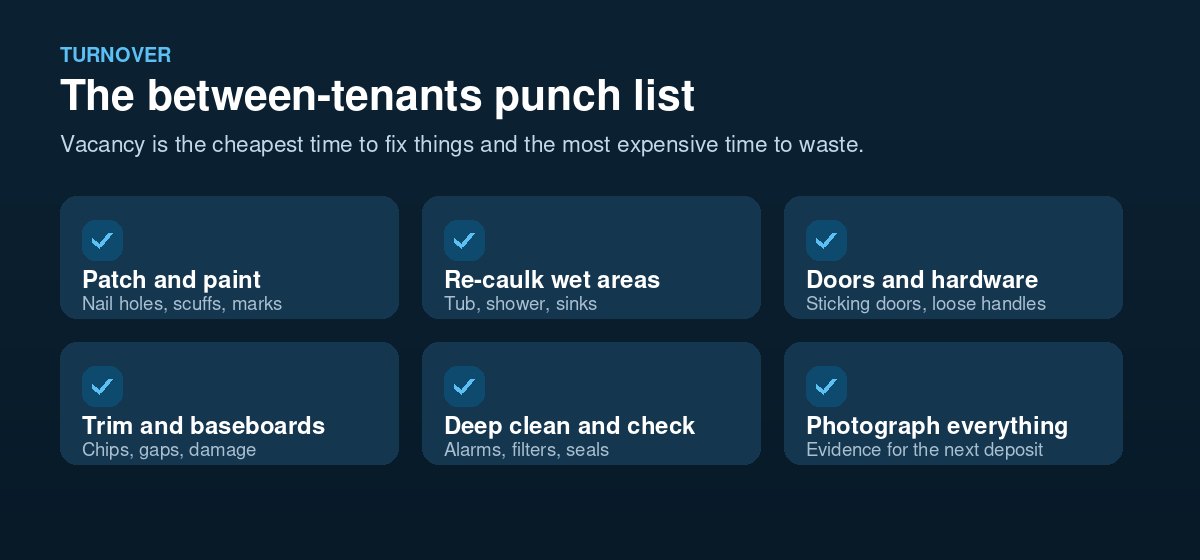
Between tenants is the one window where work is quick, access is unrestricted, and nobody is inconvenienced. It is also the window landlords most often rush, because every day empty is a day unpaid.
The trade-off is worth thinking about honestly. Two days of repairs that let you list the unit properly will usually cost less than the reduced rent or extra vacancy caused by showing a tired unit.
A practical turnover list looks like this:
- Patch nail holes and repair any drywall damage properly, not with a smear of filler
- Touch up or repaint high-traffic walls and any room that needs it
- Replace failed caulking in kitchens and bathrooms
- Fix sticking doors, loose handles and damaged trim and baseboards
- Test alarms, replace filters, check every window and lock
- Photograph everything before the next tenant moves in
That last one matters more than people expect. A dated photo record of the unit’s condition is what makes a deposit claim work, and what protects you if a dispute reaches the RTB.
How a handyman helps landlords and property managers
Most rental maintenance is not one trade. A turnover might need drywall, paint, caulking, a door adjustment and a light fixture — five specialists, or one handyman in a single visit.
That is the practical case for using a handyman for rental property maintenance: fewer bookings, fewer call-out fees, and a shorter turnaround between tenants. For landlords with several units, it also means one number to call rather than a contact list.
What we typically handle for rental properties
- Repairs between tenants — the full punch list in one visit while the unit is empty
- Drywall repair — anchor holes, dents, cracks and water-damaged sections patched and blended
- Painting and touch-ups — full repaints or targeted work on the walls that actually need it
- Caulking and sealing — tubs, showers, sinks, backsplashes and exterior joints
- Doors and trim — sticking doors, worn hinges, damaged casing and baseboards
- Furniture assembly — useful for furnished units and short-term rentals
- Wall panels and finishing — durable feature walls that stand up to tenant turnover
- Minor repairs and ongoing maintenance — fixtures, shelving, blinds, hardware and the seasonal checklist above
Work that legally requires a licensed trade — electrical, gas and major plumbing — is not handyman work, and any honest handyman will tell you so rather than attempt it. There is more on that line in our guide to handyman services in Burnaby.
Managing more than one property? HANDYGO works with landlords and property managers across Coquitlam, Port Moody, Port Coquitlam, Burnaby and New Westminster. Get a free quote or call (604) 760-4292 and tell us how many units you look after.
Frequently asked questions about rental property maintenance
What does rental property maintenance include?
Routine inspections, preventative work such as caulking and gutter clearing, repairs during a tenancy, and the turnover work between tenants — drywall, paint, doors, trim and fixtures. It also covers keeping safety items such as smoke alarms in working order.
How often should a landlord inspect a rental property?
A seasonal rhythm works well for most properties, with a thorough inspection at every turnover. In BC, landlords must give proper written notice before entering an occupied unit, so inspections need scheduling rather than dropping in.
Who pays for repairs in a BC rental?
The landlord is responsible for most repairs, including the structure, plumbing, heating and supplied appliances. Tenants pay for damage they, their guests or their pets cause, but not for reasonable wear and tear.
Can I require a tenant to repaint before moving out?
No. RTB Policy Guideline 1 says a tenant cannot be required to paint as a condition of tenancy, and such a term is unenforceable. A tenant may be responsible for repainting only where it is needed because of damage they caused.
Is it worth hiring a handyman instead of doing repairs myself?
For simple jobs on a single property, DIY is often fine. It stops making sense when you own several units, when turnover speed affects your income, or when the work is visible finishing such as drywall, trim and paint where quality is obvious.
Do you work with property managers on multiple units?
Yes. Recurring maintenance and multi-unit work are straightforward to arrange, and grouping jobs into one visit is usually the most economical approach.
Keep small problems small
Rental property maintenance is not complicated work. It is mostly a scheduling problem — knowing what to check, checking it consistently, and dealing with small things while they are still small.
Landlords who do that spend less overall, turn units around faster, and have fewer disputes. Those who defer maintenance end up paying for it anyway, usually at a worse time and a higher price.
HANDYGO handles rental property maintenance and repairs across Coquitlam, Port Moody, Port Coquitlam, Burnaby and New Westminster — from a single turnover to ongoing work across a portfolio. See everything we offer, or tell us about your properties and we will quote it.
Ready to get your units in shape? Get your free, no-obligation quote today, or call (604) 760-4292. Mon–Sat, 8am–6pm.
